

Alberta just took a city that had become the country’s most interesting small-scale infill experiment and put it on a three-month clock.
On October 8, the province ordered Edmonton to return housing types, density and height to the rules that existed before its 2024 zoning overhaul. Minimum on-site parking must go back to the pre-2020 standard. Calgary, having already repealed its citywide rezoning, was told to keep its current approach while it completes a broader review.
The timing is odd. Both cities posted record housing starts in 2025. Edmonton started 21,337 homes, up 16 per cent. Calgary started 27,684, up 14 per cent. Those are not projections or lobby-group estimates. They are CMHC’s final 2025 counts.
The province is applying the brakes just after the supply response showed up.
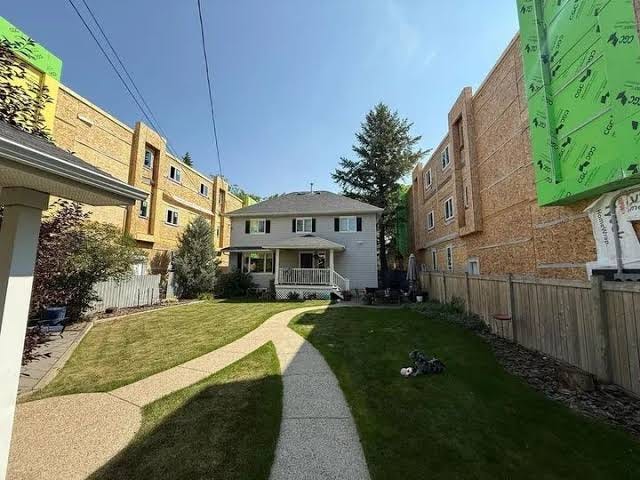
That does not mean every eight-plex belongs on every block. Some Edmonton projects have produced reasonable complaints about parking, scale, construction and how little neighbours knew before demolition began. But a blanket rollback will not sort good infill from bad. It will change what can be financed, permitted and built across the city, including projects that never caused the backlash.
What Alberta actually ordered
The province’s October 8 direction is specific.
Edmonton has three months to amend its bylaw. Housing types, density and height must return to the parameters in place before 2024. Parking minimums must return to what existed before Edmonton adopted open-option parking in 2020. The city then gets 18 months for a fuller review with public and industry consultation.
Calgary’s instruction is different. It must maintain the rules now in effect and create an overlay showing land restored to the old low-density zones while its review continues through 2027.
Alberta calls the move a pause and a reset. Edmonton Mayor Andrew Knack has called it coercion and warned that council could be removed if it defies the order. One practical question remains more urgent than the constitutional chest-thumping: what happens to applications already in the system?
The provincial release does not answer that. Anyone holding an Edmonton infill site should get a written answer from the city before relying on today’s zoning in an acquisition or construction schedule.
The numbers behind the fight
Edmonton’s Zoning Bylaw 20001 took effect on January 1, 2024. It reduced residential zones from 16 to six and opened more neighbourhoods to small multi-unit housing. The city had already removed mandatory parking minimums in 2020.
According to the permit tracking cited in the episode, 693 permits produced 5,187 homes in five-to-eight-unit projects in mature neighbourhoods from January 2024 through the third quarter of 2026. That was roughly 13 per cent of the 41,104 homes Edmonton permitted over the same period.
The wording matters. It was 5,187 homes, not 5,187 multiplex buildings. Still, roughly one in eight permitted homes is far beyond a pilot project. Small-scale infill became a real part of the city’s housing production.
The city had also started tightening the rules before the province stepped in. Edmonton’s own infill guidance shows a reduced 9.5-metre height limit that took effect in August 2026, plus setbacks, site-coverage limits and minimum site area per unit.
There was room to keep adjusting. The province chose a rewind.
Calgary did not become “corridors only”
Calgary’s path is easy to flatten into a slogan, so the details matter.
Citywide rezoning took effect in August 2024, moving most low-density properties into R-CG. Council voted 12–3 to repeal it on April 8, 2026. The repeal took effect August 4, returning about 99 per cent of affected properties to their earlier zones, with exemptions for projects already approved or in the system.
R-CG still exists. Its rules got tighter: maximum height fell from 11 metres to 10, lot coverage dropped from 60 per cent to 55, and zero-lot-line projects were removed. Secondary suites became a permitted use in all low-density districts. Council kept the R-CG density cap at 75 units per hectare.
The city is studying more growth around nodes, corridors, transit and brownfield sites, but that work is not finished. The City of Calgary’s repeal page says the broader review lands in 2027.
For now, Calgary is back to its old zoning map with a narrower R-CG tool. Edmonton is being ordered toward its old framework on a much shorter timetable.
Why the politics should bother free-market conservatives
Premier Danielle Smith has described a family watching the house next door become a 16-unit project without notice or parking. If a project overwhelmed a mid-block site and treated neighbours as an inconvenience, anger is predictable.
The current Edmonton small-scale zone generally permits up to eight units on an interior lot, subject to lot size. That does not disprove the Premier’s example; a corner parcel or different zone could allow more. It does show why the anecdote should not carry the whole policy debate.
There is a market argument for multiplexes that gets lost in the shouting. Small projects let a local owner or builder add housing without assembling a tower site or raising institutional capital. They spread development opportunity across more people. A conservative government should be careful when it overrules that market because some projects were clumsy.
There is also a governance argument. Municipal zoning will never be sacred, and the province has the legal power to intervene. Yet a rulebook that can be rewritten from above after land has traded and designs have been paid for carries a price. Lenders price uncertainty. Builders shorten their pipeline. Landowners wait. Housing becomes more expensive before anyone pours concrete.
Builders helped create some of this backlash
The industry should not pretend the opposition appeared out of nowhere.
When a builder treats the neighbour as the last person who deserves a call, that neighbour often becomes the first person writing council. When every square foot is pushed to the bylaw maximum, the argument shifts from housing supply to whether the building belongs on the street at all.
A legal project can still be a bad neighbour.
The operating checklist is not complicated: confirm water and utility capacity early, plan for real parking demand even when the bylaw says zero, design the transition beside a bungalow, and talk to the people next door before demolition fencing arrives. None of that requires giving neighbours a veto. It does reduce the number of people who feel they were ambushed.
The podcast’s line was blunt: build like the neighbours will read the permit. They do.
What buyers, investors and owners should do now
For Edmonton infill buyers, underwrite the pre-2024 envelope until the city confirms otherwise. A site that only works at six or eight units should be treated as conditional, not bankable. Put zoning and permit protection into the deal. Do not pay for density that may disappear before closing.
For builders with applications underway, document every submission date and get the city’s transition guidance in writing. Existing applications may receive protection, but the provincial release does not say so.
For Calgary investors, the old map is back. R-CG remains available where it still applies or through a rezoning application, but the as-of-right citywide shortcut is gone. Watch the 2027 nodes-and-corridors review rather than assuming the replacement policy already exists.
For homeowners, the rollback may reduce the odds of a large mid-block infill next door. It may also push more growth to the edge, with the roads, pipes and services that follow. The cost does not disappear. It moves.
Edmonton proved that zoning reform can produce a meaningful volume of housing. It also proved that speed, design and neighbour relations matter. Alberta’s response may cool the worst projects. It will also cool good ones.
That trade is now being made for the whole city.
Listen to Episode 448: Did Alberta Just Kill Edmonton’s Multiplex Boom?