

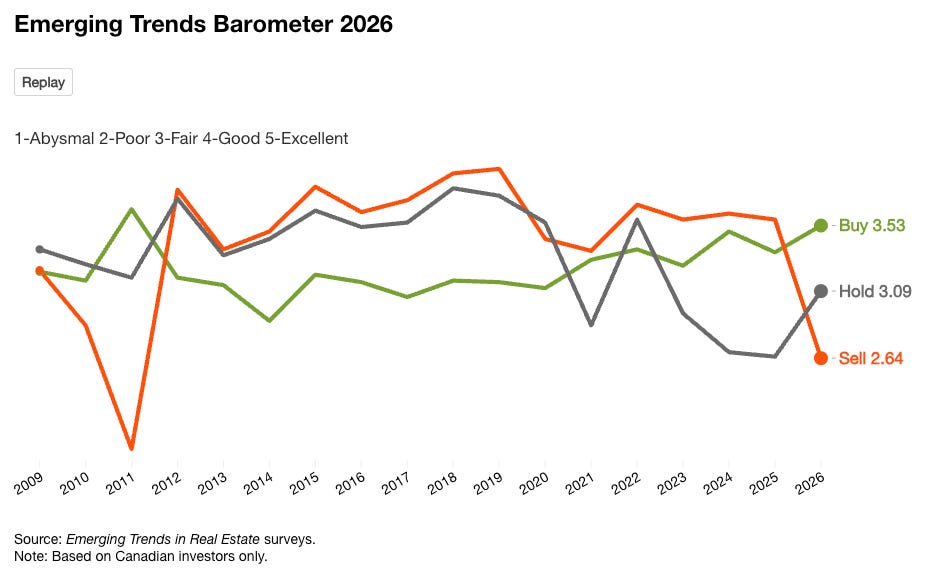
“Real estate right now is like driving in fog. Drive too slow, and you’ll get hit from behind. Drive too fast, and you’ll fall off a cliff.”
That line from PwC’s Emerging Trends in Real Estate 2026 report is probably the most accurate description of the Canadian property market I’ve heard in years.
The old playbooks aren’t working anymore.
The risks are asymmetric.
And the cost of standing still is rising faster than the cost of being wrong.
What emerges clearly from the report isn’t just caution — it’s a call for reinvention.
Listen to the episode:
The Condo Model Broke. Now What?
Nowhere is reinvention more urgent than in the condo market.
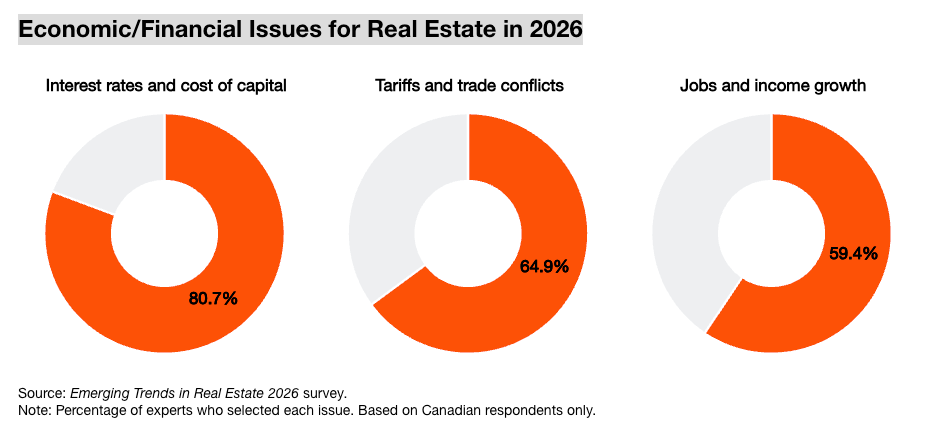
The presale-heavy, investor-driven financing model that defined the last cycle is cracking. Rising rates, softer investor demand, and mounting delivery risk have exposed how fragile that structure really was. The result isn’t just fewer condo starts — it’s a forced rethink of how projects get financed at all.
One developer in the report put it bluntly:
“There will be innovation in this time because we have no choice.”
That sentiment runs through the entire industry.
This Isn’t Just a Real Estate Problem
PwC’s broader Value in Motion research shows something bigger at work: trillions of dollars in economic value are about to move across sectors as climate constraints, demographic shifts, and AI reshape how the economy functions.
In 2026 alone, companies reinventing their business models are expected to capture US$7.1 trillion in redistributed global revenues.
Real estate isn’t immune to this disruption — but it is uniquely positioned to sit at the center of it.
Why? Because every one of these shifts ultimately needs land, buildings, infrastructure, and capital.
The New Growth Map: Real Estate as Infrastructure
PwC frames the future around six “domains of growth” tied to fundamental human needs — how we fuel, connect, care, and build.
Each domain has a real estate core.
1. Fuel & Power: Buildings as Energy Assets
The decarbonization of the grid is turning buildings into infrastructure.
Developers are no longer just managing energy costs — they’re creating energy revenues.
Examples already moving from theory to practice:
Geothermal systems justified not by ESG optics, but by long-term cash flows
Solar-covered industrial roofs feeding power back into the grid
Battery storage embedded directly into building materials
In this model, a building isn’t just shelter.
It’s a power plant with tenants.
2. Connect & Compute: The Data Centre Constraint
AI doesn’t run on vibes — it runs on electricity, land, and cooling.
That’s why data centres keep ranking as a top real estate opportunity. But the story here has matured. The era of speculative land banking for “future compute” is giving way to balance-sheet reality.
Power availability, capital intensity, and execution risk are thinning the field.
The opportunity now looks less like:
“Everyone builds data centres”
And more like:
“The right players partner, retrofit, acquire, and operate.”
Real estate’s role isn’t disappearing — it’s becoming more specialized.
3. Care: Aging, Housing, and the Silver Economy
Demographics are destiny, and Canada’s is aging fast.
Seniors’ housing sentiment has flipped sharply positive. But the opportunity goes far beyond traditional long-term care.
The report highlights:
Medical office buildings insulated from economic cycles
Community-based care replacing centralized hospital delivery
Gentle density models that allow seniors to age in place while adding units for caregivers
This is where housing, health policy, and technology collide — and where real estate operators start to look more like service providers.
4. Build: Modular Housing’s Financing Problem
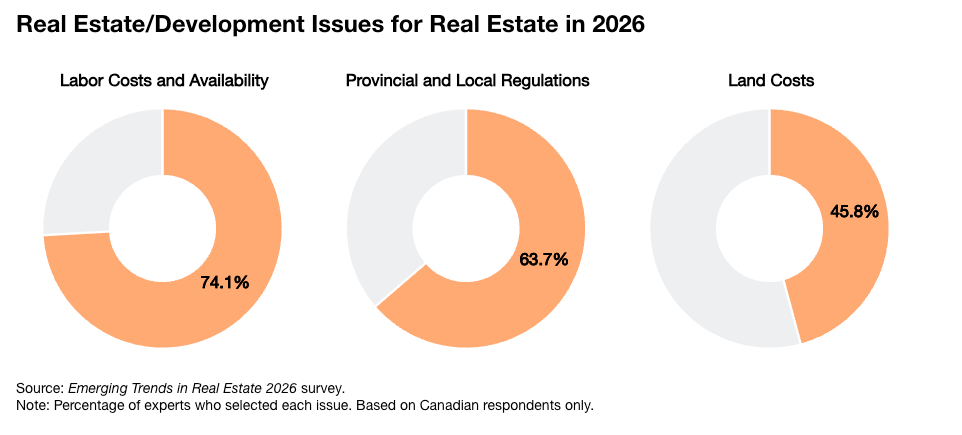
Everyone agrees Canada needs to build faster.
Everyone likes modular housing in theory.
In practice, it’s stuck.
Not because the buildings don’t work — but because the financing doesn’t.
Traditional construction loans release capital as on-site milestones are hit. Modular construction needs capital upfront for factories, inventory, and manufacturing runs. That mismatch is one of the biggest barriers to scale.
The report is clear: modular only works if financing models change.
That likely means:
Governments acting as first buyers
Bulk procurement to smooth demand
New private financing structures tied to production cycles, not site visits
Without that, modular remains a niche — not a solution.
AI: From Efficiency Tool to Business Model
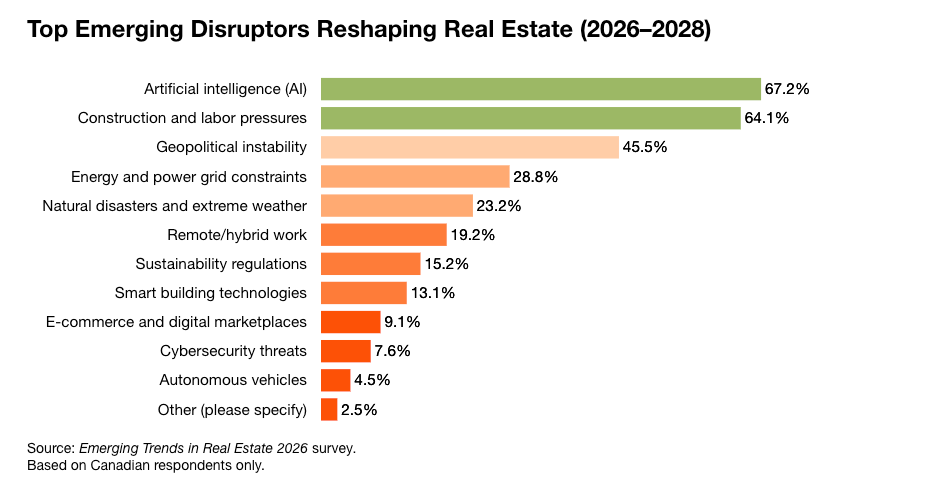
AI adoption in Canadian real estate has quietly crossed an important line.
The early phase — pilots, chatbots, admin tools — is ending.
Now we’re seeing:
AI leasing agents improving conversion rates
Dynamic pricing adjusting rents in real time
Predictive maintenance lowering operating costs
Automated lease abstraction saving thousands of hours
But the most important shift is what comes next: agent AI.
Not chatbots.
Not dashboards.
Autonomous systems that act.
Agent AI will:
Qualify leads and match properties
Generate documents and manage transactions
Monitor portfolios in real time
Compress deal timelines
Reduce operating costs
Raise the bar for firms that don’t adopt
This is less about “using AI” and more about whether your business model survives without it.
The Real Constraint: Data, Not Technology
One of the most honest insights in the report is that AI adoption isn’t being limited by ambition — it’s being limited by data.
Fragmented systems.
Legacy property software.
Inconsistent standards across provinces.
Quebec, driven by Law 25, is already pulling ahead with centralized data governance. The rest of the country is behind — and that gap will compound quickly.
AI doesn’t fail quietly.
It fails expensively.
The Bottom Line
Canadian real estate is no longer just about location, leverage, and timing.
It’s about:
Cross-sector partnerships
New financing structures
Operating businesses, not just assets
Treating buildings as infrastructure
Competing in ecosystems, not silos
The fog isn’t lifting anytime soon.
But one thing is clear:
The firms that try to wait it out will get hit from behind.
The ones that sprint without a plan will fall off the cliff.
Reinvention isn’t optional anymore — it’s the only safe speed.
Based on insights from PwC and the Urban Land Institute, Emerging Trends in Real Estate® 2026.