Canadians like to talk about housing as if it were weather.
Prices rise. Rates fall. A city gets hot. A market cools. We describe the outcome, then invent a story about supply, demand or national psychology.
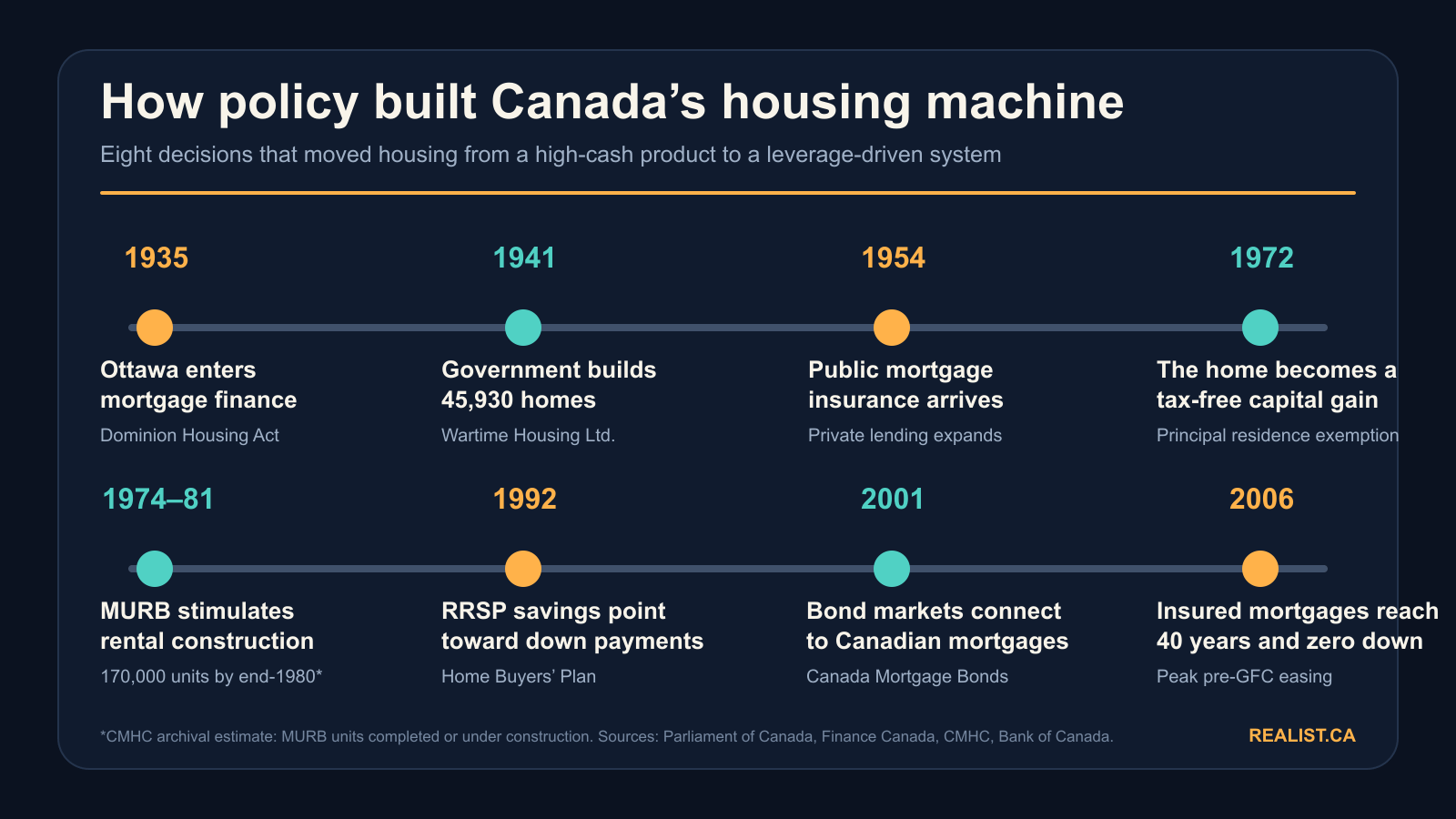
But the deeper story is more deliberate. Canada’s housing system was built through a century of policy choices: who could lend, how much buyers could borrow, which risks taxpayers would absorb, which gains would be taxed and which forms of housing were worth subsidizing.
The market is what happened downstream.
In this episode of The Canadian Real Estate Investor, Nick Hill and I trace the first half of that history—from the fragile mortgage contracts of the 1920s to zero-down, 40-year insured mortgages in 2006.
Listen to the episode
The original mortgage system was built to break
In 1926, home financing looked nothing like a modern mortgage.
A typical borrower needed roughly half the purchase price in cash. The loan might run for three to five years, with interest-only payments and the full principal due at the end. There was no long amortization steadily paying down the balance.
The arrangement worked only if the borrower could refinance when the balloon payment arrived.
Then the Depression removed the next lender. Property values fell, incomes disappeared and refinancing dried up. The problem was not merely that the economy turned. The product itself had no protection against a bad credit cycle.
Ottawa responded with the Dominion Housing Act in 1935 and the National Housing Act in 1938. These were early, limited moves, but they established a principle that would define the next century: housing finance was now a federal policy concern.
When Ottawa wanted housing, it built housing
The Second World War created a different emergency. Industrial employment surged, workers moved to production centres and cities faced acute shortages.
In 1941, the federal government created Wartime Housing Limited and became a direct builder. A Parliament of Canada history credits the Crown corporation with 45,930 units over eight years.
The federal response was not a buyer credit, an insured loan or a tax-preferred savings account. It was finished housing.
When Wartime Housing’s assets moved into the newly created CMHC in 1946, the federal government retained the machinery of housing policy—but its most important future role would be financial rather than physical.
1954: the invention of modern Canadian leverage
The decisive shift came in 1954.
Public mortgage insurance reduced the lender’s exposure to borrower default, and chartered banks entered mortgage lending. A CMHC historical review explains that the system created a nearly risk-free mortgage investment for lenders and increased the supply of private funds.
This is the origin of a central Canadian housing bargain: use the public balance sheet to make private mortgage credit deeper, cheaper and more widely available.
It worked. Homeownership stopped being a product only for households capable of producing enormous down payments. Millions of Canadians gained access to housing and long-term wealth formation.
But it was still a choice. Default risk did not disappear; it moved. Once that lever existed, governments could keep adjusting how much credit the system would create.
1972: the house becomes Canada’s favourite tax shelter
Canada introduced capital-gains taxation through the 1972 tax reform while exempting qualifying principal residences.
The Department of Finance describes the exemption as a policy intended to recognize shelter and make it easier for families to move. Its behavioural effect is broader: leveraged gains on a principal home can accumulate tax-free.
Combine that exemption with insured mortgage credit and the incentive becomes powerful. For an ordinary household, a larger owner-occupied home is not only shelter. It is also one of the few investments that can be heavily financed and sold without tax on the qualifying gain.
Canadians did not become obsessed with housing in a vacuum. The rules taught them where to store wealth.
The MURB lesson: supply responds when the incentive is real
Not every policy pushed ownership demand.
In 1974, the federal Multiple Unit Residential Building program allowed investors to use capital-cost-allowance losses from qualifying rental buildings against other income. It made apartment construction attractive to private capital.
A CMHC program evaluation estimated that about 170,000 MURB units were completed or under construction by the end of 1980. The measure ended in 1981.
The larger lesson is not that one tax rule can solve housing. It is that supply responds when policy makes projects economically viable. Canada spent decades adding tools that helped buyers assemble more purchasing power, while letting major rental-building incentives fade.
Demand support is politically immediate. Supply takes years. That timing problem has shaped almost every housing cycle since.
Policy moves the map, too
There has never been one Canadian housing market.
In the 1970s, political and language changes in Quebec contributed to corporate head offices and capital shifting from Montreal toward Toronto. Western Canada moved to the rhythm of oil booms, the National Energy Program and commodity busts. Around the 1997 Hong Kong handover, migration and capital helped turn Vancouver into a more globally connected market.
Local fundamentals still matter. But the centre of gravity moves when federal policy, provincial policy and global capital flows change the incentives around a city.
That is why a national headline can be directionally right and practically useless for a buyer in Calgary, an apartment owner in Montreal or a seller in the GTA.
The 1989 crash broke the “always up” story
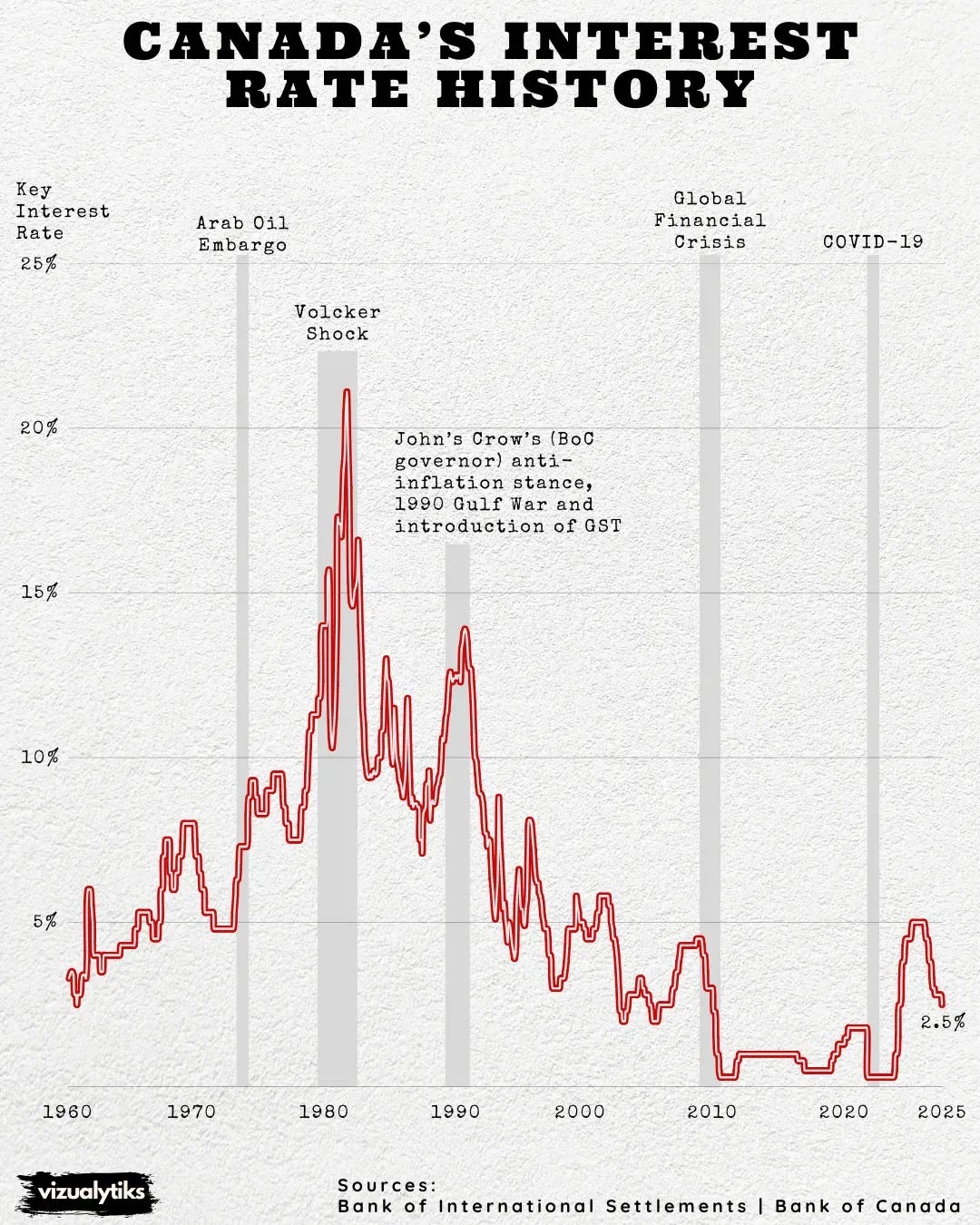
Falling interest rates and speculation drove Toronto into a late-1980s peak. The subsequent decline lasted years, not months.
CMHC’s long-run house-price series shows the national index peaking in 1989, dropping through the early 1990s and remaining below that nominal level until the early 2000s.
That is the uncomfortable history hidden by a long bull market. Policy can expand credit and soften downturns. It cannot repeal cycles, eliminate regional risk or guarantee a quick recovery.
From RRSP down payments to a global mortgage conveyor belt
The response to the early-1990s slump was a new era of easier financing.
The Home Buyers’ Plan arrived in 1992, letting buyers withdraw RRSP funds for a down payment. A Finance Canada history notes that the temporary measure became permanent in 1994.
Five-per-cent down payments became increasingly normal. Then, in June 2001, CMHC introduced the Canada Mortgage Bond program.
The CMB program connected insured mortgages to domestic and international bond investors through government-guaranteed securities. Lenders could fund mortgages at scale, recycle capital and originate more loans.
This plumbing is less visible than a down-payment rule, but arguably more important. It connected global pools of low-risk capital directly to Canadian household borrowing.
By 2006, insured mortgage rules had expanded to 40-year amortizations and zero-down loans. A Bank of Canada staff paper documents how quickly the limits moved that year.
Canada had travelled from 50% down and a five-year balloon to 100% financing stretched over four decades.
What buyers and investors should take from this history
Read policy before reading sentiment. Down-payment rules, insurance limits, tax treatment and mortgage funding can matter more than a month of sales data.
Separate access to credit from affordability. A rule that lowers the monthly payment can also let buyers bid more for the same housing stock.
Never confuse a government backstop with a guaranteed investment return. Insurance protects the lender; it does not protect the owner’s equity.
Match the analysis to the region. Toronto, Montreal, Vancouver and Alberta have repeatedly lived through different cycles.
Stress-test the holding period. The 1990s showed that recovering from a housing peak can take more than a decade.
What sellers and homeowners should understand
The tax treatment of a principal residence is a major advantage, but it should not turn one asset into an entire retirement strategy.
Policy can create purchasing power, and purchasing power can support prices. It can also be reversed. The same government that loosens insurance or amortization rules can tighten them when debt and speculation become political risks.
For sellers, the most important buyer is often the marginal borrower. A change that reduces that buyer’s financing capacity can affect market value faster than local homeowners expect.
The bottom line
Canada’s housing market was never simply the product of population growth, scarce land or cultural preference.
It was engineered through mortgage insurance, tax exemptions, rental incentives, savings programs and government-guaranteed funding. Those decisions expanded ownership and created enormous wealth. They also concentrated household balance sheets, pulled demand forward and made housing unusually sensitive to policy.
The practical edge is to stop treating the market like weather.
Somebody signed something. The next cycle will have a signature, too.
This article is for educational and informational purposes only. It is not financial, legal, tax, mortgage or investment advice.