

The easiest way to misunderstand Canadian housing this fall is to look at one national price number and stop reading.
The average sale price rose 0.6% year over year in August. The MLS Home Price Index fell 3%.
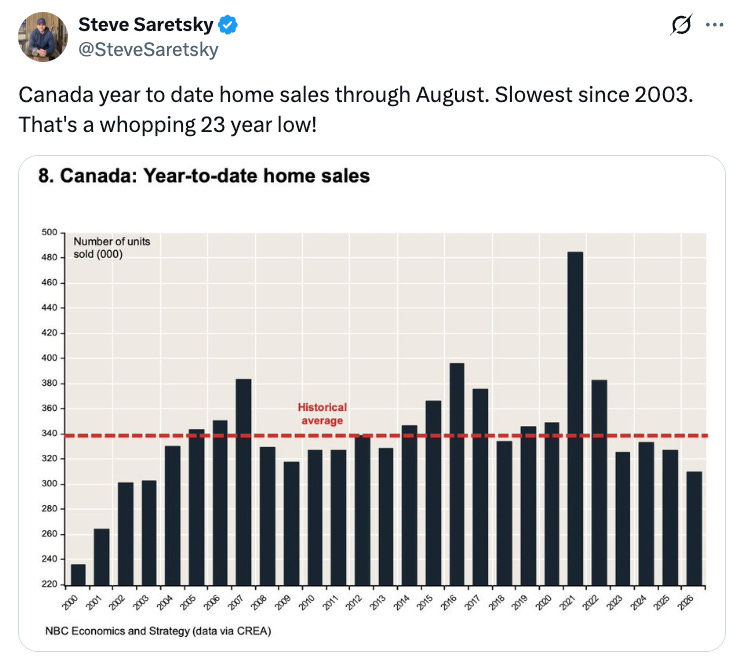
Those figures are not contradictory. The average changes when the mix of homes and markets being sold changes. The HPI tries to track the price of a comparable home over time. A few more expensive transactions can lift the average while values are still falling across much of the country.
That is not a recovery. It is a reminder that the national average is often the least useful number in the release.
August gave us a more honest signal: listings woke up and buyers did not.
The market has been stuck since May
CREA reported 37,504 sales in August, down 6.9% from a year earlier. Seasonally adjusted activity slipped 0.7% from July and has gone almost nowhere for four months.
That is a stall print, not a crash print.
The distinction matters. A crash creates forced decisions. A stall lets everyone tell themselves a better market is six weeks away. Sellers delay price cuts. Buyers keep watching. Agents talk about the fall market as if the calendar itself produces demand.
New listings rose 3.3% month over month after three declines. But actual listings were still 3.2% below last August, so this was not a flood. It was a seasonal bump that buyers did not match.
The sales-to-new-listings ratio fell from 51.1% to 49.1%. CREA’s long-term average is 54.7%. Months of inventory sat at 4.8 for the fourth consecutive month.
“Balanced” is technically correct. It is not a compliment. Bargaining power is drifting toward buyers even without a dramatic inventory spike.
Every province sold fewer homes than last August
The broadest weakness was not a national price decline. It was the map.
Every province recorded fewer sales than a year earlier. Ontario, the country’s largest market, posted 13,620 transactions, down 6%.
Price performance was much less uniform. The HPI was down 7.1% in the Fraser Valley, 6.1% in Kitchener-Waterloo, 5.6% in Vancouver and 4.5% in the GTA. Meanwhile, Regina was up 3.3%, Winnipeg 2.6%, Montreal 2.3% and St. John’s 7.5%.
St. John’s does not rescue a seller in the GTA. Alberta income supported by higher oil does not pay a Toronto buyer’s mortgage. Prairies and Atlantic Canada are not Ontario and British Columbia with better branding.
Stop saying “the Canadian market” like it is one MLS.
For buyers and sellers, the practical unit of analysis is the local segment: property type, price range, neighbourhood, financing profile and how much competing inventory is actually usable. The national number is context, not a price opinion.
Oil can reach your mortgage before it reaches your listing
Housing was not the only market moving this week.
The episode was recorded after a sharp oil move pushed Brent above $108 and revived inflation concerns. The exact daily close will change. The transmission mechanism will not.

Higher energy costs can feed inflation expectations. That can push bond yields higher. Five-year fixed mortgage rates are priced from that bond market, not from the latest Bank of Canada press conference. CREA’s own economist noted that fixed mortgage rates had already risen with bond yields and that markets were again pricing some risk of a variable-rate hike.
That does not mean one oil spike guarantees higher mortgage rates. It means a buyer waiting for an easy fall-rate rescue is making a macro bet, whether they admit it or not.
Energy markets may get an income boost while expensive housing markets get rate pain. Same country. Different movie.
The Mega Deduction is not a mortgage cut
Ottawa’s Productivity Mega Deduction is real policy, but most housing commentary is putting it in the wrong column.
The proposal expands permanent immediate expensing from a narrow group of assets to roughly two-thirds of capital investment. The federal government says the change would cut Canada’s marginal effective tax rate on new investment from 13% to 6.4%.
For an equipment-heavy operator, infrastructure business or developer buying eligible assets, the timing of deductions can improve a project’s economics. It may change when capital gets deployed.
It does not lower a homebuyer’s five-year fixed rate. It does not make a weak resale condo cash-flow. Most ordinary residential buildings are excluded from the new immediate-expensing treatment.
That is the hierarchy for a real estate pro forma:
Mortgage and construction-credit terms.
Local revenue, cost and absorption assumptions.
Tax treatment for assets that actually qualify.
Government announcements that may never reach your file.
Do not move the fourth item to the top because the press release has a large number in it.
A financing pledge is not a construction draw
The Canada Investment Summit produced large commitments and larger headlines. The Prime Minister said pension funds, insurers and institutional investors had committed nearly $100 billion in new capital to Canadian assets. Banks also announced broad financing capacity across energy, critical minerals, defence, AI and infrastructure.
That is useful if your project fits one of those lanes.
A suburban multiplex does not become financeable because a bank put a nine-figure pledge on a summit slide. A mid-market borrower still needs a credit memo that clears, an appraisal the lender accepts and a construction budget with enough contingency.
Committed capacity is not funded capital. A press conference is not a draw schedule.
The sector tags matter more than the round number. If the money is aimed at digital infrastructure or critical minerals, do not casually underwrite it into a housing project.
What buyers, investors and sellers should do with this
Buyers: Use the listing bump. More choice with a softer sales-to-new-listings ratio is leverage, even if the market remains technically balanced. Do not confuse leverage with a guaranteed discount on every good property.
Sellers: Price against competing listings that buyers can actually purchase. August did not produce the fall demand bounce many listing calendars assumed.
Investors: Treat average-price gains as a mix warning, not appreciation evidence. Underwrite the local HPI trend, achievable rent, financing cost and exit liquidity.
Builders and operators: Review the Mega Deduction with a tax adviser asset by asset. The policy may matter for eligible equipment, software and infrastructure. It is not a blanket residential-development subsidy.
Everyone: Watch the quote path. The next CREA release arrives October 16, before the Bank of Canada’s October 28 decision. Housing data will land first. The rate argument comes after.
There is no clean national fall market to call.
Sales are stuck. Sellers added some inventory. Buyers gained a little leverage. Regional prices are moving in different directions, while oil and bond yields are threatening the rate relief many people expected to do the work for them.
Map first. Financing second. National average last.
Listen: Market Updates, Mega Tax Deductions & The Investor Summit on Spotify
Sources: CREA, August 2026 national statistics; Department of Finance, Productivity Mega Deduction; Prime Minister of Canada, Investment Summit remarks; episode script package in Notion.
This article is for educational purposes and is not financial, legal, tax or investment advice.