Four years after the 2022 peak, the Canadian housing market is finally showing signs of a floor.
National sales have risen for three straight months. Prices stopped falling in June. Inventory tightened. And in Ontario, the pipeline for new single-family homes has thinned to levels not seen in decades.
That sounds bullish—until you look at the household balance sheet.
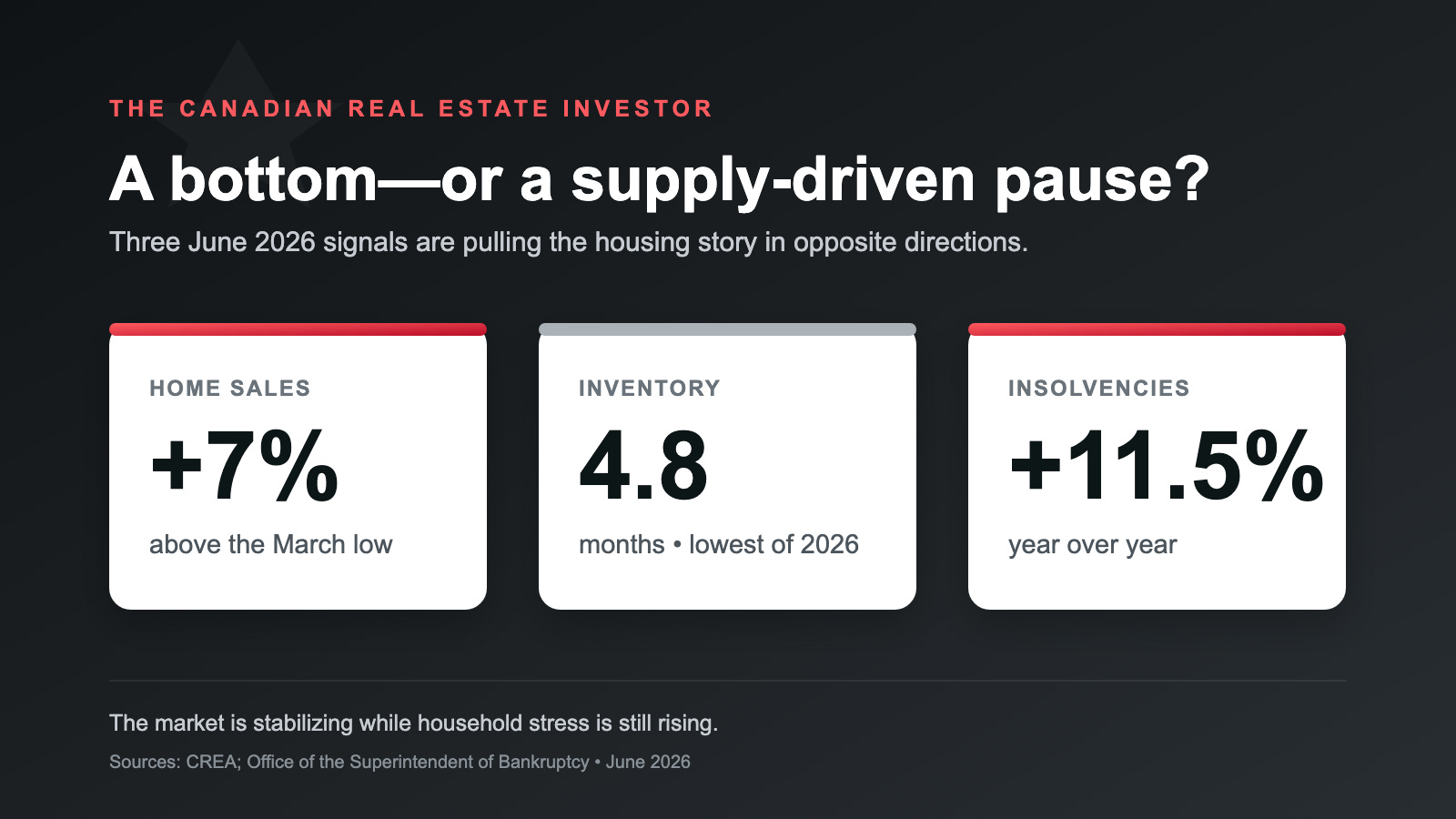
More than 13,000 Canadians filed for insolvency in June, up 11.5% from a year earlier and 5.7% from May. The country is now running near the insolvency levels seen during the global financial crisis.
So which story is real?
Both of them.
The market may be finding a bottom, but it is not doing so because buyers suddenly feel rich or because the economy is roaring back. It may be finding a bottom because sellers are pulling listings, builders have stopped building, and lower prices plus lower borrowing costs are finally bringing a small amount of demand off the sidelines.
That is a floor. It is not yet a recovery.
The case that the bottom is forming
The latest national data finally moved in the same direction for more than one month.
According to CREA’s June 2026 report, home sales rose 0.5% from May. That followed a 5.5% jump in May and a 0.9% increase in April, leaving sales roughly 7% above the March low.
The national MLS Home Price Index was flat month over month. That may not sound exciting, but after a long correction, “not falling” matters. Markets usually stabilize in stages: transaction volume improves first, inventory tightens next, and prices respond last.
BMO economist Robert Kavcic has described the current phase as the price-destruction portion of the cycle running its course—especially for single-family homes. His important caveat is that a return to strong price growth is still some distance away, and the condo market remains weaker. BMO’s housing analysis makes the same distinction we keep stressing on the podcast: there is no single Canadian housing market.
Nationally, there were 4.8 months of inventory at the end of June, the lowest level so far in 2026 and close to the long-run average. But that balanced national number hides radically different markets by region, property type, neighbourhood and quality.
A renovated family home in a supply-constrained neighbourhood can receive multiple offers while an investor condo a few kilometres away sits for months. Both transactions appear in the same “Canada” headline. They are not the same market.
This floor may be built on shrinking supply
Here is the uncomfortable part of the bullish case: some of the apparent stabilization is happening because supply is disappearing.
New listings have started to ease. Builders are cancelling or delaying projects that no longer pencil. Ontario single-family completions have fallen to levels last seen around 1990, according to the housing data discussed in this episode. Toronto condo starts are also collapsing from recent norms.
That can create a price floor without creating a healthy market.
If fewer owners list and fewer builders complete homes, the available inventory can tighten even when demand remains historically weak. It is the housing equivalent of a store looking busy because half the shelves are closed.
This is why “the market bottomed” and “the market is strong” are not interchangeable statements.
A supply-driven bottom can still be real. It can also be fragile. If unemployment rises, mortgage renewals create forced sales, or bond yields push fixed mortgage rates higher, more listings could arrive before demand is ready to absorb them.
The insolvency data is the counterweight
The June insolvency figures are a warning against getting carried away.
Canada recorded more than 13,000 insolvency filings during the month. That was an 11.5% increase from June 2025 and a 5.7% increase from May, according to figures from the Office of the Superintendent of Bankruptcy reported by The Canadian Press.
Most filings were consumer insolvencies. The pressure is straightforward: high household debt, stagnating purchasing power and mortgage payments resetting at higher rates.
Insolvencies do not automatically produce a wave of distressed home sales. Canadian borrowers often cut spending, refinance, sell other assets or use a proposal long before a lender takes possession. But the trend matters because it tells us how thin the household cushion has become.
A market can stabilize at the same time its weakest participants are being forced out.
That is not a contradiction. It is price discovery.
Bottom does not mean boom
Calling a bottom is emotionally satisfying because it sounds like certainty. In reality, bottoms are processes, not dates.
The most likely path from here is not another 2020–2022 surge. It is a slow, uneven and highly regional grind:
Sales volumes recover before prices.
Quality properties move; compromised properties linger.
Single-family homes stabilize before investor-heavy condos.
Supply-constrained markets firm while weaker employment markets remain soft.
Fixed mortgage rates stay vulnerable to inflation and global bond-market shocks.
We may look back and decide the national market bottomed in the middle of 2026. But even if that turns out to be right, some cities and property types could still fall further.
What buyers should do
Do not buy because an economist used the word “bottom.” Buy because the property works for your life and the payment still works under a stress scenario.
That means comparing the monthly cost of ownership with the realistic cost of renting, keeping a proper emergency fund, and testing the payment against a renewal rate that is higher than today’s best advertised rate.
Most importantly, negotiate the property in front of you—not the national headline. In a split market, condition, location and seller motivation matter more than the average benchmark price.
What investors should do
Underwrite the deal with today’s rent and today’s financing. Treat appreciation as optional.
The current market rewards durable cash flow, conservative leverage and properties with multiple exit paths. It punishes thin spreads, heroic rent assumptions and the belief that every unit will recover at the same speed.
If your thesis depends on a sharp rebound next year, it is not an investment thesis. It is a timing bet.
What sellers and homeowners should understand
Price discovery has returned. Buyers have data, choice and patience. A stale listing usually becomes harder—not easier—to sell.
If you need to transact, price to the most recent comparable sale, not to the 2022 memory of the property. If a mortgage renewal is approaching, model the payment now and speak with a broker early. Optionality is most valuable before you need it.
The bottom line
The Canadian housing market has absorbed several major shocks: the fastest rate-hiking cycle in decades, an affordability crisis, a collapse in investor demand and years of falling real prices.
The fact that sales are rising and national prices have stopped sliding deserves attention.
But this is not a victory lap.
The floor appears to be forming while household stress is still climbing and the construction pipeline is breaking. That combination could stabilize prices in the short run while creating the next supply problem in the long run.
The best description is not “the market is back.”
It is this:
Canada may be finding a housing floor—but it is a floor built by scarce supply, cautious demand and very little room for error.
Listen to the full conversation on Apple Podcasts, or use the player above.
If you are working through a multiplex project in Toronto, join us at Unpacking Multiplexes.
This article is for educational purposes only and is not financial, legal or investment advice.