

Listen to the full news episode here:
Ontario Housing Is Fracturing — And Everyone Is Feeling It
Ontario’s housing market isn’t moving in one direction right now.
It’s splitting.
On one side, regulators are cracking down harder than we’ve seen in years. On another, city policy says “build more housing” while committees quietly block it. Builders are freezing projects. Sales are collapsing. Prices are sliding. And at the same time, mortgage arrears are rising — but not exploding.
This isn’t a crash story.
It’s a structural stress story.
Let’s unpack what’s really happening.
1. The Trust Account Crisis: RECO Draws a Line in the Sand
Real Estate Council of Ontario (RECO) just suspended four Save Max brokerages and froze their accounts after discovering $2.7 million unlawfully disbursed from trust accounts.
That money was reportedly used for:
Loan payments
Property management fees
Taxes
Credit card balances
Vendor services
All things that are explicitly not allowed.
This is the second major trust breach in under a year, following the $10.5 million iPro Realty scandal, the largest in Ontario history.
What’s different this time?
Speed.
Instead of slow enforcement and procedural drift, RECO:
Suspended brokerages immediately
Froze accounts
Proposed revoking registrations
This is happening shortly after the Ontario government stepped in to restructure oversight.
Translation: the regulator is signaling that trust accounts are no longer negotiable.
For consumers, that’s stabilizing.
For brokerages cutting corners on cash flow? It’s a warning shot.
2. Multiplex Policy vs. Political Reality
Toronto’s “gentle intensification” policy was supposed to unlock small apartment buildings along major streets.
Two nearly identical roads.
Two six-storey proposals.
Two completely different outcomes.
Islington Avenue (Etobicoke) — Approved
Scaled six-storey project
Zoning amendment secured
Committee approval granted
Pharmacy Avenue (Scarborough) — Rejected
Six-storey building
Supported by planning staff
Rejected over parking and “neighbourhood character”
Now under appeal
Both streets were redesignated in 2024 as “major streets” under Toronto’s EHON initiative to allow small apartment buildings up to six storeys.
Yet legacy rules — some dating back to the 1950s — are still being applied inconsistently.
This matters.
Because right now:
High-density towers aren’t penciling
Mid-rise projects are stalled
Small developers are stepping in to fill the gap
If committee decisions contradict council policy, smaller builders and non-traditional investors may simply walk away.
And that’s dangerous — because this is exactly the type of modest rental supply that can move quickly in a frozen market.
3. The RBC–REALTOR.ca Power Move
Royal Bank of Canada (RBC) has partnered with REALTOR.ca to integrate financial advice directly into the home search journey.
On paper:
Mortgage guidance embedded in listings
Financial literacy content
AI-enabled advice tools
A smoother path from browsing to financing
Is this good or bad?
It depends who you are.
For consumers:
Potentially helpful.
Less friction.
More clarity on affordability.
For agents:
It signals vertical integration.
The search portal and lender are getting closer.
For the industry:
It’s another step toward platform consolidation.
This isn’t just marketing.
It’s ecosystem building.
4. Residential Construction Is Collapsing
This is the most serious story in Ontario housing right now.
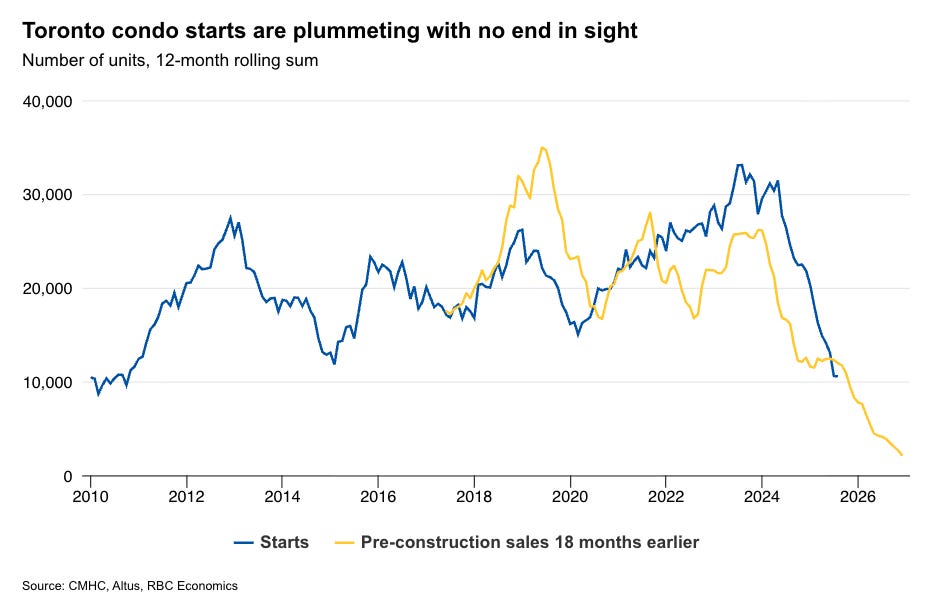
The numbers are not subtle:
Toronto housing starts: down 58%
GTHA single-family sales: down 71%
Condo sales in some segments: down 90%
2025: worst GTA new home sales year in 45 years
Building Industry and Land Development Association confirmed it.
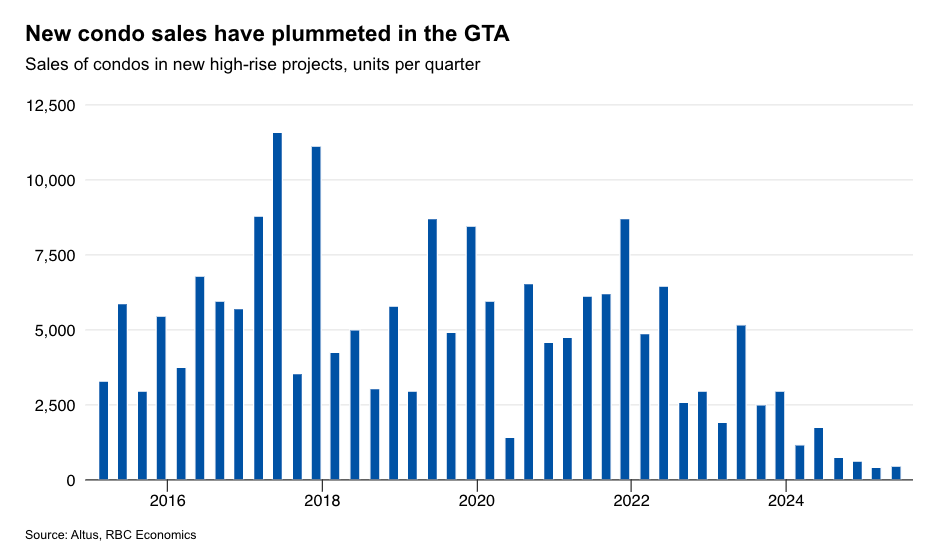
Prices have softened.
Costs have not.
Land.
Labour.
Development charges.
Interest.
Materials.
When selling prices drop but costs stay fixed, projects stop.
And when projects stop:
Construction jobs fall
Supplier orders shrink
Municipal revenues decline
GDP weakens
Ontario’s economy could contract 1.5–2.5% in 2026 purely from the housing slowdown.
Housing isn’t just shelter in this province.
It’s macroeconomic infrastructure.
5. Prices Back Under $1 Million
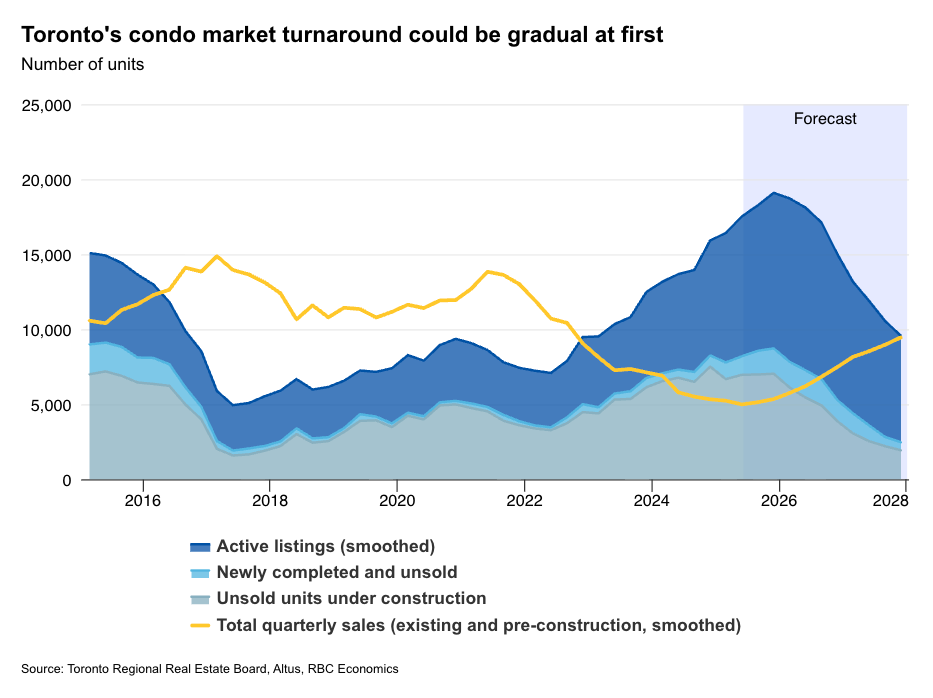
The average GTA home price has dipped below $1 million for the first time in several years.
Toronto Regional Real Estate Board data shows:
Listings are up
Buyers are cautious
Homes are sitting longer
Negotiating power has shifted
This isn’t 2022 panic.
It’s a slow grind toward balance.
Condos are softer than low-rise.
Inventory is climbing.
Sentiment is cautious.
But this is not a liquidity collapse.
Which brings us to the final piece.
6. Mortgage Arrears Are Rising — But Not Breaking
Canada Mortgage and Housing Corporation analysis shows:
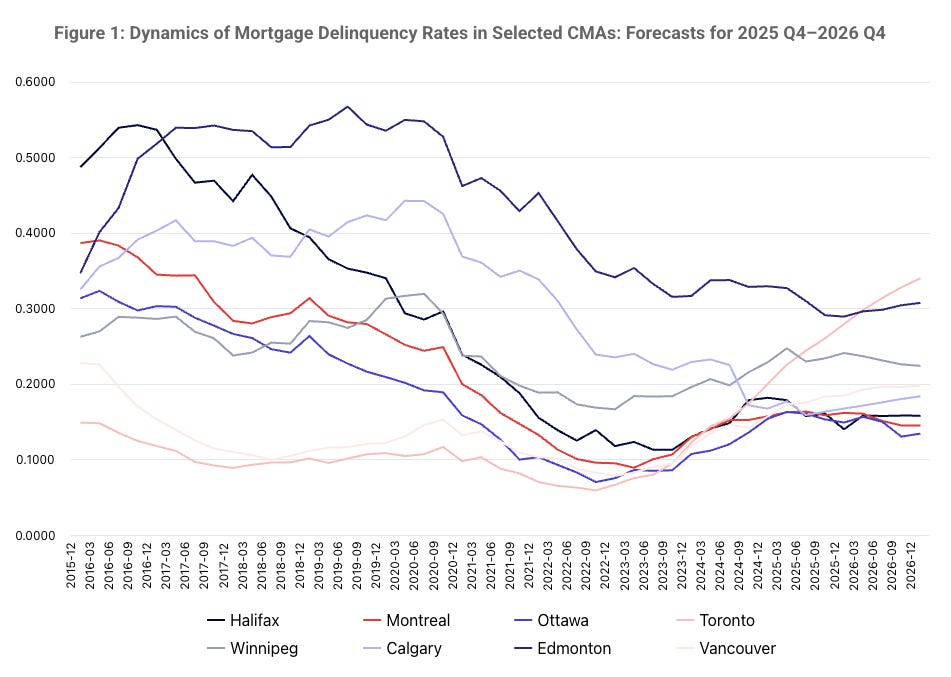
Arrears up 7 basis points since 2023
Toronto and Vancouver most exposed
Pandemic-era first-time buyers most vulnerable
Highly leveraged households under stress
More than 1.5 million households have already renewed at higher rates.
Another 1 million will renew this year.
Yet arrears remain historically low.
Why?
Stress testing worked.
Borrowers extended amortizations.
Income growth (until recently) supported payments.
Regulation prevented excess risk layering.
This isn’t a national delinquency crisis.
It’s a localized, concentrated strain story.
Toronto leads.
Vancouver follows.
Other regions remain relatively stable.
The Bigger Picture
Put it all together and a clear pattern emerges:
Regulators tightening enforcement
Policy contradictions slowing supply
Builders unable to build
Buyers cautious
Prices softening
Mortgage strain rising — but contained
Ontario housing isn’t imploding.
It’s constricting.
And constriction is dangerous in a province where housing represents an outsized share of GDP.
The next 12–24 months will hinge on three things:
Policy alignment — will zoning, committees, and provincial goals actually match?
Cost reform — development charges, HST, approval timelines.
Labour market stability — unemployment is the true arrears trigger.
If those stabilize, this becomes a painful reset.
If they don’t, Ontario doesn’t just face a housing issue.
It faces an economic one.