

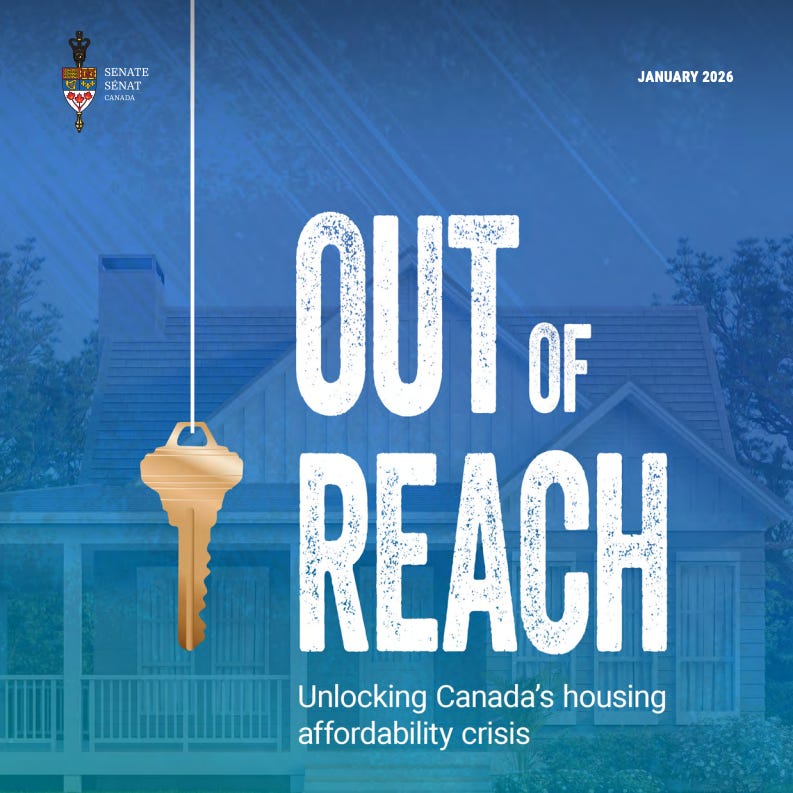
The January 2026 Senate report, titled “Out of Reach: Unlocking Canada’s Housing Affordability Crisis,” is one of the most comprehensive government analyses of why housing has become unaffordable across the country. After months of hearings with economists, developers, policy experts, and industry leaders, the committee came back with over 20 recommendations targeting three critical bottlenecks: the rental market, development charges, and approval delays.
The numbers are staggering. In Toronto, a new home now carries roughly $200,000 in municipal fees alone — before you even count the price of the land and construction. Meanwhile, it takes an average of 11 years from the first planning meeting to move-in day for a new development. These aren’t abstract statistics — they explain why housing costs have spiraled out of control.
On the rental side, the committee heard testimony that Canada’s tax system overwhelmingly favours homeownership over renting, locking out a growing share of Canadians who can’t afford to buy. Witnesses including economists Armine Yalnizyan and policy experts like Mike Moffatt and David Wilkes praised recent federal moves — the removal of GST on new purpose-built rentals and CMHC’s Apartment Construction Loan Program — but warned that far more needs to be done. The committee even floated studying restrictions on institutional investors buying up rental housing, a signal that big landlords could face new rules.
Development charges emerged as another major culprit. The report revealed that Ontario municipalities are sitting on over $12 billion in collected but unspent development charge reserves — money taken from builders (and passed to buyers) that hasn’t been turned into the infrastructure it was collected for. As KingSett Capital’s Jon Love put it: “The fundamental issue is we tax housing at a level that makes it unaffordable.”
And then there’s the approval process. The average municipal decision on a development application takes nearly 12 months, but in cities like Hamilton and Toronto, it can stretch to 25–31 months — and that’s after years of pre-application work. Research cited in the report found that these delays add roughly $58,000 per unit in extra costs for a typical apartment building. Every month a project sits waiting for approval is a month that families aren’t in those homes.
The committee’s recommendations range from tying federal infrastructure funding to development charge reductions, to incentivizing municipalities to adopt faster digital permitting systems, to exploring tax benefits for renters comparable to what homeowners enjoy. It’s a mix of carrots and sticks aimed at every level of government.
For investors, the takeaway is clear: the rules of the game may be about to change. Lower development fees could make marginal projects viable. Faster approvals could shorten timelines and improve returns. New rental incentives could boost the case for purpose-built rental construction. But potential restrictions on institutional ownership and a shift toward renter-friendly policy mean strategy adjustments may be necessary.
Whether these recommendations translate into action remains to be seen — but the fact that Canada’s Senate is calling for this level of reform signals that the political will for change is building.