

Fred Cassano had completed about 185 interviews for PwC and the Urban Land Institute’s annual real estate report when he sat down with me. Across asset classes, the same word kept surfacing: bottom.
I joined the chorus, with a qualifier.
If the turn is real, sales volume should improve before prices do. More buyers step in as assets get cheaper. Some sellers refuse the new clearing price and leave the market. The bid-ask spread narrows, transactions resume, and only then do prices get a chance to move.
That is less exciting than calling the exact month of the bottom. It is also more useful.
This episode is unusual because Fred interviews me. We get into where retail capital went, whether condo discounts are investable, what aging will do to housing, and why AI still cannot be trusted to lay pipe on the 70th floor.
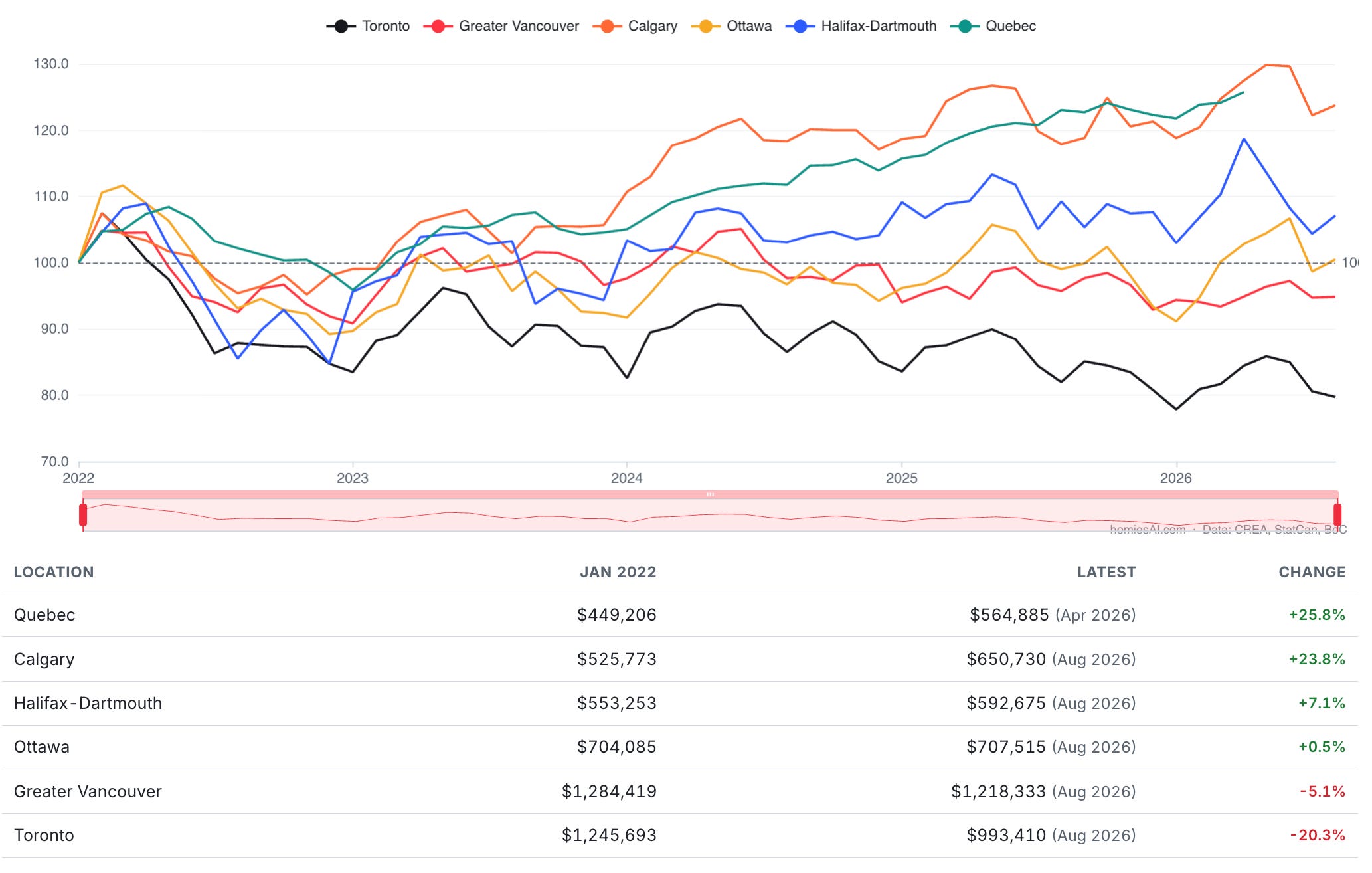
The common thread is not recovery. It is dispersion.
Canada no longer has one coherent real estate trade. We have several markets moving at different speeds, with different buyers and completely different tolerances for risk.
The word “bottom” needs a verb
Large investors are already doing things.
Institutional money is recapitalizing or privatizing REITs, buying multifamily, pursuing data centres and looking seriously at seniors’ housing. On the condo side, large funds have been buying standing inventory at discounts that a retail buyer cannot negotiate unit by unit.
The retail investor is mostly somewhere else.
The investor bid has largely disappeared from detached housing. Pre-construction speculation is dead. The exception is small-scale multifamily financed through CMHC’s MLI Select program, where long amortizations and insured debt can make cash flow possible.
That shift was not accidental. Policy tried to move investor capital away from homes competing with owner-occupiers and toward new rental supply. It worked.
Condo developers are studying smaller rental projects they can sell or hold. Former condo investors are looking at builder-grade multiplexes, particularly in Alberta. If insured financing moves down to three- and four-unit buildings, this market could change quickly.
Calling all of that “real estate demand” hides the plot.
Condos may be getting a floor, not a recovery
Retail buyers are starting to ask about completed and resale condos again, but the underwriting has changed.
A buyer may accept that a condo will recover eventually, but still wants rent to carry the debt while waiting. In the interview, I used 75% financing as the rough test. Deals that pass remain rare.
The more interesting signal is below retail.
Large funds are buying blocks of inventory at deep discounts, sometimes below resale values. That does not guarantee a retail bottom. It creates a reference bid where none existed.
My read is that this becomes a more visible retail trend through 2027. First, volume. Price comes later.
Policy is now an operating variable
Real estate people like to talk about policy as if it were weather. It is closer to plumbing. Change a valve and capital moves somewhere else.
The federal foreign-buyer ban is scheduled to expire. I argued that allowing it to lapse would be politically easier than an explicit condo rescue. Provincial taxes and capital controls abroad had already reduced that buyer group, so the impact may be modest.
Tax relief on new housing may matter more. I cited a 160% year-over-year increase in new-home sales following GST/HST relief, while flagging the low base. It is not proof of a rebound. It shows that transaction costs move behaviour.
The practical lesson is blunt: do not underwrite policy as permanent. Model the deal with the incentive, without it, and with it delayed.
“Office” is not an investment thesis
The office numbers make the dispersion impossible to miss.
PwC and ULI report a national vacancy rate of 18.7% in the second quarter of 2025. Core trophy buildings were at 10.6%. Class B and C space was at 25.3%.
Return-to-office mandates are helping the best buildings in major centres. Some large tenants are running out of space. Long leases are attracting interest again.
None of that rescues an obsolete building with the wrong floor plate, weak amenities and no obvious conversion economics.
This is the market we are in: the label on the asset matters less than the building, tenant mix, financing and micro-location. “Office is back” is as careless as “office is dead.”
The aging question is bigger than seniors’ housing
I called aging the most important real estate trend in the Western world over the next 25 years. That is not simply a bullish call on retirement homes.
The harder question is what happens when the largest owner cohort becomes a seller and the next generation cannot afford the same houses at the same price-to-income ratio.
Many older Canadians hold most of their middle-class wealth in a primary residence. Reverse-mortgage balances keep growing because owners want liquidity without moving. Downsizing often means trading a detached house for an expensive bungalow or a condo they do not want. The choices are thin, and staying put is rational.
That creates room for more interesting housing products.
I described a builder offering to construct an accessible garden suite for an older owner, then replace the house with a multiplex. The owner remains on the land long term while the builder receives the new asset out front. It addresses the actual constraint instead of telling a senior to move to a tower.
Other owners may prefer a well-run rental apartment in the same community, sell the house, and be free to lock the door for the winter. Whoever gives this cohort a credible choice will find demand. Whoever treats it as a simple “silver tsunami” trade will discover that seniors’ housing is an operating business with regulation, care and reputational risk attached.
AI has hands now. It still needs judgment.
The most useful AI discussion was not about chatbots writing leasing copy.
AI models already know much of the public internet. The scarce input is practical knowledge trapped in people’s heads: how an experienced inspector reads a foundation, how a foreman sequences a job, how a skilled trade notices that something is wrong before the drawings reveal it.
Smart glasses and local recording tools can capture that work as it happens. An inspector could narrate a walkthrough and receive a draft report. A contractor could turn site observations into estimates and deficiency lists. The value is a reliable system grounded in private, specific data.
That creates a privacy problem. I described experimenting with a local, always-on note-taking system because the data stays on my devices. That tolerance is not universal. Smaller firms can move faster because they carry less compliance burden than a national institution.
Robotics is earlier. A hallucinated paragraph is annoying. A robot making a millimetre-level error in concrete on a 70-storey job is a multimillion-dollar change order. Construction automation will have its moment, but current economics and error rates still matter.
Homeownership may stop being Canada’s default business plan
The final trend is uncomfortable because it sits beneath all the others.
For decades, Canadians treated the principal residence as the default wealth engine. That produced forced savings and enormous household wealth. It also concentrated capital in one illiquid asset.
Millennials and Gen Z are being forced to consider a different arrangement. Some will rent longer and invest elsewhere. Others will buy when the numbers improve. Ownership is becoming a calculation again, not a civic duty.
That change could redirect capital toward entrepreneurship at exactly the moment AI lets a small operator compete with a much larger firm.
What I would do with this
Buyers: Watch transaction volume and the quality of listings, not just the benchmark price. A quiet improvement in sales is more informative than another dramatic bottom headline.
Investors: Underwrite the actual asset and operator. Sector labels are nearly useless when trophy-office vacancy is less than half the Class B/C rate.
Homeowners and sellers: Treat aging-in-place, garden suites and small multiplexes as real planning options, but solve ownership, financing, tax and access questions before touching the structure.
Developers: Run every pro forma with incentives removed. If a deal only works because a temporary policy survives your entire construction period, it does not work yet.
There probably is a bottom forming somewhere in Canadian real estate. It will not arrive as one national index announcing that every asset is safe again.
It will show up first in volume, then in specific buildings, specific buyer groups and specific financing structures. By the time the median price confirms it, the useful part of the turn may already be behind us.
Sources: The Most Important Trends In Real Estate; PwC and ULI, Emerging Trends in Canadian Real Estate 2026; full United States and Canada report. This article is for educational purposes and is not financial, legal, tax or investment advice.