
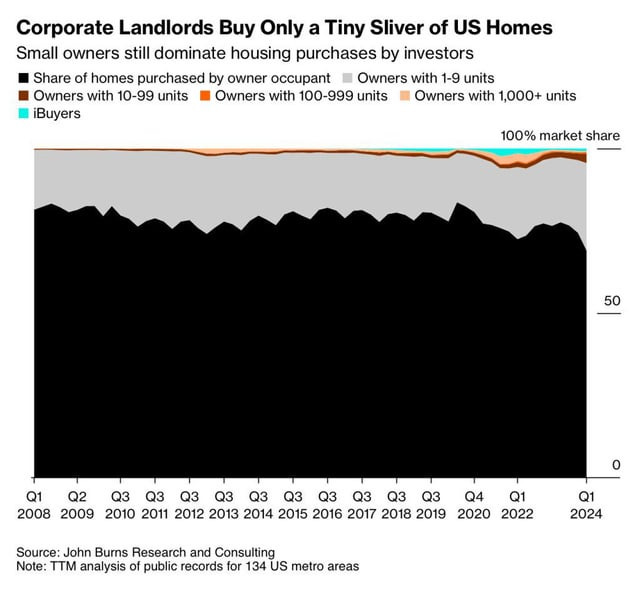
President Trump’s recent housing announcements have dominated headlines: a $200 billion mortgage bond-buying spree and a ban on large institutional investors purchasing single-family homes. While the mortgage rate intervention grabbed immediate attention—rates briefly dipped below 6% for the first time since 2023—it’s the corporate landlord ban that reveals a fundamental misunderstanding of how to channel institutional capital toward solving the housing crisis.
The numbers tell an interesting story. According to the American Enterprise Institute, large institutional investors own roughly 1% of total single-family housing stock in the U.S.—about 450,000 homes out of millions. That’s a tiny fraction, yet it’s become a political lightning rod. Trump’s proposal to ban these players from buying existing homes has drawn rare bipartisan support, with progressive Democrats and MAGA Republicans finding common ground in their distrust of Wall Street landlords.
But here’s where it gets fascinating: Trump’s ban explicitly excludes newly built homes. As analyst Jina Yoon at LPL Financial pointed out, this could “actually accelerate more rental community development owned and managed by large institutional investors.” In other words, the policy might inadvertently push corporate capital exactly where we need it—into building new housing supply rather than competing for existing stock.
Canada stumbled into this solution years ago, without needing a ban at all. Through CMHC’s MLI Select program, the government created such compelling financing incentives for building multi-family rental housing that institutional investors naturally shifted from buyers to builders. The program offers up to 95% loan-to-value financing and—critically—50-year amortizations for apartment projects that score points for affordability, energy efficiency, and accessibility.
Think about what that means for cash flow. A 50-year amortization dramatically reduces monthly debt service, making it financially viable to offer below-market rents while still generating acceptable returns. Suddenly, building new affordable rental housing becomes more attractive than competing with families for existing homes. The carrot worked better than any stick.
The genius of MLI Select is that it aligns institutional investors’ profit motives with public policy goals. Want access to cheap, long-term government-backed financing? Great—build rental housing that’s affordable, green, and accessible. The program doesn’t demonize capital; it channels it.
Compare this to Trump’s approach. Banning institutional buyers from existing homes might score political points, but it does nothing to address the fundamental problem: America is 3-5 million homes short of what’s needed. Meanwhile, institutional investors have deep pockets and expertise in large-scale development. Why ban them from the market when you could incentivize them to build?
The U.S. actually has a template for this in Fannie Mae and Freddie Mac’s multifamily programs, but there’s been no equivalent push to make build-to-rent projects as financially attractive as buying existing inventory has been. Canada didn’t need Trump’s bombastic ban because we made the math work differently.
The irony is that Trump’s policy might accidentally achieve what Canada did deliberately. By excluding new builds from the ban, institutional capital may flow toward build-to-rent communities—exactly what we need to address the supply crisis. But it’s a happy accident rather than intelligent design.
Housing affordability is now a crisis on both sides of the border, with both countries near generational lows in affordability metrics. The difference is in the response: Canada created financial incentives that turned institutions from competitors into builders. The U.S. is threatening bans that may or may not survive legal challenges and could take years to implement.
The lesson? You don’t need to ban institutional capital from housing—you need to redirect it. Create financing products so attractive for new construction that buying existing homes becomes the less appealing option. Make building the path of least resistance and highest return.
Canada’s approach isn’t perfect, and we still face a severe housing shortage. But at least we figured out how to make institutions part of the solution rather than treating them purely as the problem. Sometimes the carrot really does work better than the stick.
Listen to the full episode for our deep dive into Trump’s housing policies, U.S. vs. Canadian mortgage structures, and why patience might be the best strategy for Canadian investors eyeing American real estate opportunities.